
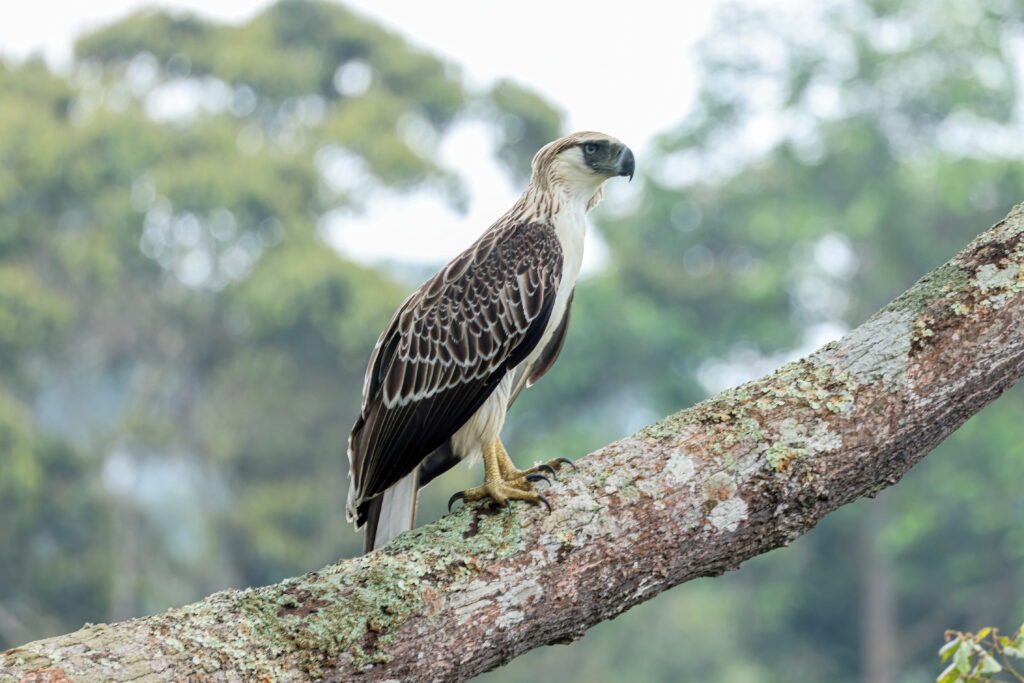
The Philippine Eagle (Pithecophaga jefferyi)—locally called Banug—is one of the largest and most powerful forest raptors in the world. With its striking brown-and-white plumage, shaggy crest, and wingspan stretching up to 220 cm, Banug embodies strength and majesty. Its formidable talons can carry prey several times its own size, making it a true apex guardian of the forest.
For the Bagobo Tagabawa people, Banug is more than a bird—it is a sacred emblem of peace, resilience, and protection. As the national symbol of the Philippines, it represents independence and power, but within Mt. Apo it also reflects the deep interconnection between culture and nature. Respect for the eagle is inseparable from respect for the forest, and visitors are reminded not to hunt wildlife or cut trees when entering tribal lands.
The Story of Datu Pawa and Banug
Long ago, a mighty eagle carried the hunter Datu Pawa to its nest high on Mt. Apo’s cliffs. There, he lived alongside a young eaglet, sharing its food and forging a bond of trust. When the eaglet was ready to fly, Datu Pawa climbed onto its back and soared home. In gratitude, he named his son Banog, who later founded the villages of Tudaya, Kapatagan, Binaton, and Sibulan at the mountain’s foot. This folklore endures as a lesson in fortitude, leadership, and harmony with nature.
Heritage and Conservation
For the Bagobo Tagabawa, the presence of Banug signifies peace and balance. Ancestors believed that as long as the eagle soared above Mt. Apo, the land would remain protected. Today, conserving the Philippine Eagle means safeguarding both a precious biological heritage and the living cultural heritage that binds people and mountain together.